Institutional News
JACS: Xiangbing Qi’s group develops an enantioselective deaminative radical C(sp3)−C(sp3) cross-coupling strategy using amino acid derivatives Highlights
Amino acids are abundant and structurally diverse chiral building blocks widely used in the synthesis of bioactive molecules and complex chiral compounds. However, the asymmetric deaminative construction of C(sp3)−C(sp3) bonds from amino acid derivatives remains a long-standing challenge. In this study, Xiangbing Qi’s group at the National Institute of Biological Sciences, Beijing / Tsinghua Institute of Multidisciplinary Biomedical Research developed a visible-light-induced nickel-catalyzed asymmetric radical cross-coupling strategy between alkylzirconocenes and amino-acid-derived Katritzky salts. This method enables efficient and highly stereoselective (up to 83% yield and 99% ee) synthesis of diverse α-chiral alkyl carbonyl derivatives under mild conditions, while providing a powerful approach for constructing challenging stereocenters with minimally differentiated alkyl substituents. Importantly, this transformation exploits the intrinsic photochemical activity of alkylzirconocenes to achieve nickel-catalyzed enantioselective radical C(sp3)−C(sp3) cross-coupling without external photocatalysts. The work entitled “Enantioselective Deaminative Cross-Coupling of Amino Acid Derivatives with Alkylzirconocenes” was published online in the Journal of the American Chemical Society on July 28, 2026.
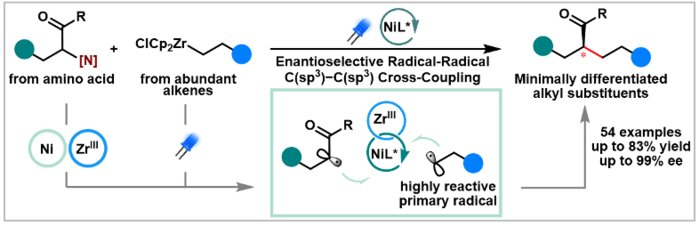
Challenges in the Asymmetric Construction of C(sp3)-Rich Chiral Molecules
C(sp3)-rich chiral molecules are widely found in pharmaceuticals, natural products, and functional materials. Their increased three-dimensionality and saturation often provide improved physicochemical and pharmacokinetic properties, making the efficient construction of such structures a central goal in modern synthetic chemistry. Traditional asymmetric C(sp3)−C(sp3) cross-coupling reactions have provided powerful strategies for assembling these architectures. However, alkyl electrophiles often suffer from sluggish oxidative addition and reductive elimination processes. Moreover, the conformational flexibility and steric congestion associated with aliphatic C(sp3) organometallic intermediates make precise stereochemical control highly challenging.
Recently, radical cross-coupling strategies have emerged as an alternative approach for C(sp3)−C(sp3) bond construction. By leveraging highly reactive open-shell intermediates, radical processes bypass the intrinsic reluctance of alkyl electrophiles in two-electron oxidative addition and expand the range of accessible coupling partners to abundant feedstocks. Among various radical precursors, amino acids are particularly attractive due to their abundance, structural diversity, and ready availability. Conversion of amino acids into Katritzky salts provides an effective platform for generating alkyl radicals under mild conditions, benefiting from their favorable single-electron reduction potential (E1/2 ~ −0.9 V vs. SCE). However, asymmetric deaminative cross-coupling remains underdeveloped, largely due to the difficulty in controlling highly reactive radical intermediates with high stereochemical precision.
Asymmetric Deaminative Coupling with Alkylzirconocenes
Drawing on its long-standing research in alkylzirconocene-mediated radical chemistry (Chem, 2020, 675; JACS, 2020, 11506; Chem, 2023, 2222; JACS, 2024, 27070), Xiangbing Qi’s group envisioned that alkylzirconocenes could provide a unique solution for the asymmetric deaminative coupling of amino acid derivatives. Alkylzirconocenes exhibit excellent functional group tolerance, unique photochemical properties, and the ability to enable remote C–H functionalization through “chain-walking” processes, making them valuable reagents for constructing complex carbon frameworks. Under visible-light irradiation, homolytic cleavage of the ClCp2Zr−C bond generates alkyl radicals and a reduced zirconium species, Cp2Zr(III)Cl (Ered ~ −1.70 V vs. SCE). This process enables catalytic turnover without the need for external photocatalysts or sacrificial reductants. Taking advantage of the complementary redox properties of Katritzky salts and Cp2Zr(III)Cl, the researchers developed a visible-light-driven, nickel-catalyzed enantioselective deaminative cross-coupling reaction. In this catalytic system, alkylzirconocenes serve dual roles as radical precursors and regulators of the metal catalytic cycle, establishing a new mode of cooperative control between radical generation and transition-metal catalysis.
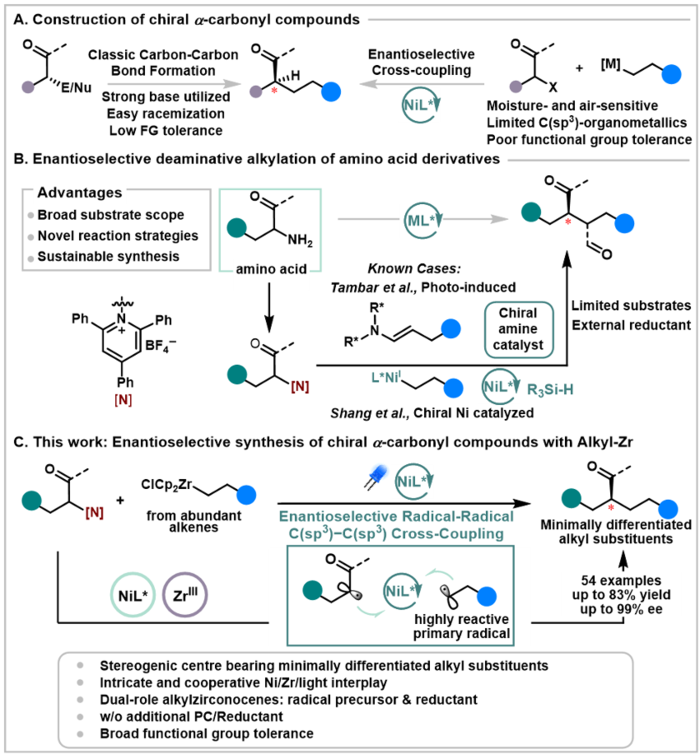
Figure 1. Strategy for asymmetric C(sp3)−C(sp3) cross-coupling
Efficient Construction of α-Chiral Alkyl Compounds
Through systematic optimization, the researchers employed a chiral BOX ligand as the stereocontrol element and a nickel catalyst under blue LED irradiation to achieve efficient synthesis of α-chiral alkyl compounds. The substrate scope studies demonstrated that the reaction accommodates a broad range of amino-acid-derived Katritzky salts and alkylzirconocenes generated through in situ hydrozirconation of alkenes. Notably, this strategy maintained excellent reaction efficiency and enantioselectivity even for the construction of stereocenters containing minimally differentiated alkyl substituents, addressing a longstanding challenge in asymmetric synthesis. Furthermore, crude Katritzky salts without purification and mixtures of alkene isomers could be directly employed in the reaction. A gram-scale experiment also proceeded efficiently with maintained stereoselectivity, highlighting the synthetic practicality of this method.
Mechanistic Studies
To gain mechanistic insights into this asymmetric deaminative coupling reaction, the researchers conducted a series of mechanistic investigations. Radical clock and stereoconvergent experiments demonstrated the generation of open-shell alkyl radical intermediates from Katritzky salts during the reaction. Moreover, enantiomeric starting materials afforded the same product enantiomer, indicating that the stereodetermining step is catalyst-controlled, rather than substrate-controlled. Because both Cp2Zr(III)Cl and reduced nickel species possess single-electron transfer capabilities, a series of control experiments were performed to clarify their respective roles. The results showed that although Cp2Zr(III)Cl is capable of reducing Katritzky salts, it is not the dominant pathway responsible for radical generation. Instead, single-electron transfer between Ni(I) species and Katritzky salts is likely the key process for radical generation. Additionally, nonlinear effect studies indicated that a single chiral ligand is involved in the stereodetermining step, providing insight into the origin of enantioselectivity in this cross-coupling reaction.
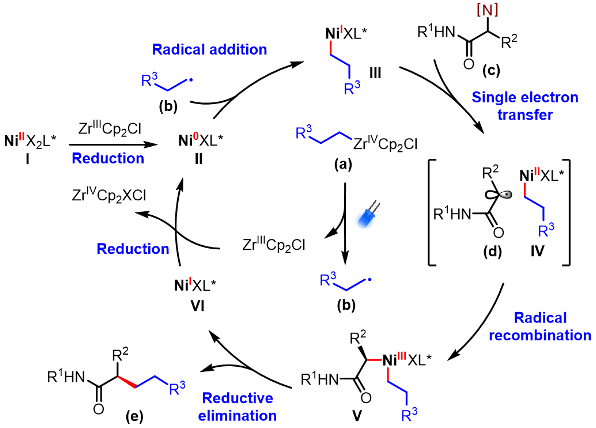
Figure 2. Proposed mechanism
Conclusion
In summary, Xiangbing Qi’s group developed a visible-light-promoted nickel-catalyzed asymmetric deaminative C(sp3)−C(sp3) cross-coupling strategy, enabling the efficient synthesis of high-value chiral alkyl molecules from amino acid derivatives and alkenes. This work expands the application of deaminative radical transformations in asymmetric synthesis and highlights the unique potential of alkylzirconocenes in photochemical radical coupling reactions. The developed strategy provides a new platform for the rapid construction of complex chiral molecules.
Team & Support
Dr. Xiangbing Qi is the corresponding author. The first author is Yuee Ke (Ph.D student) in Xiangbing Qi’s group. Other authors include Linlin Fan (Ph.D student) and Dr. Gen Li in Xiangbing Qi’s group. This work was supported by grants from the National Key R&D Program and the National Natural Science Foundation of China (2025YFA1309001 and 82225041) and Beijing Natural Science Foundation (Z230020).
Paper link: https://pubs.acs.org/doi/10.1021/jacs.6c10406